


At least a quarter of children in the UK are growing up multilingual, with all the cognitive and social benefits this entails. Being able to think, talk, write, and live in two languages is undoubtedly an advantage that all teachers are supportive of, but integrating multilingualism in the classroom can feel a little daunting. This is why, this World Book Day, we have teamed up with Professor Sabine Little, Professor of Literacy and Multilingualism at the University of Sheffield.
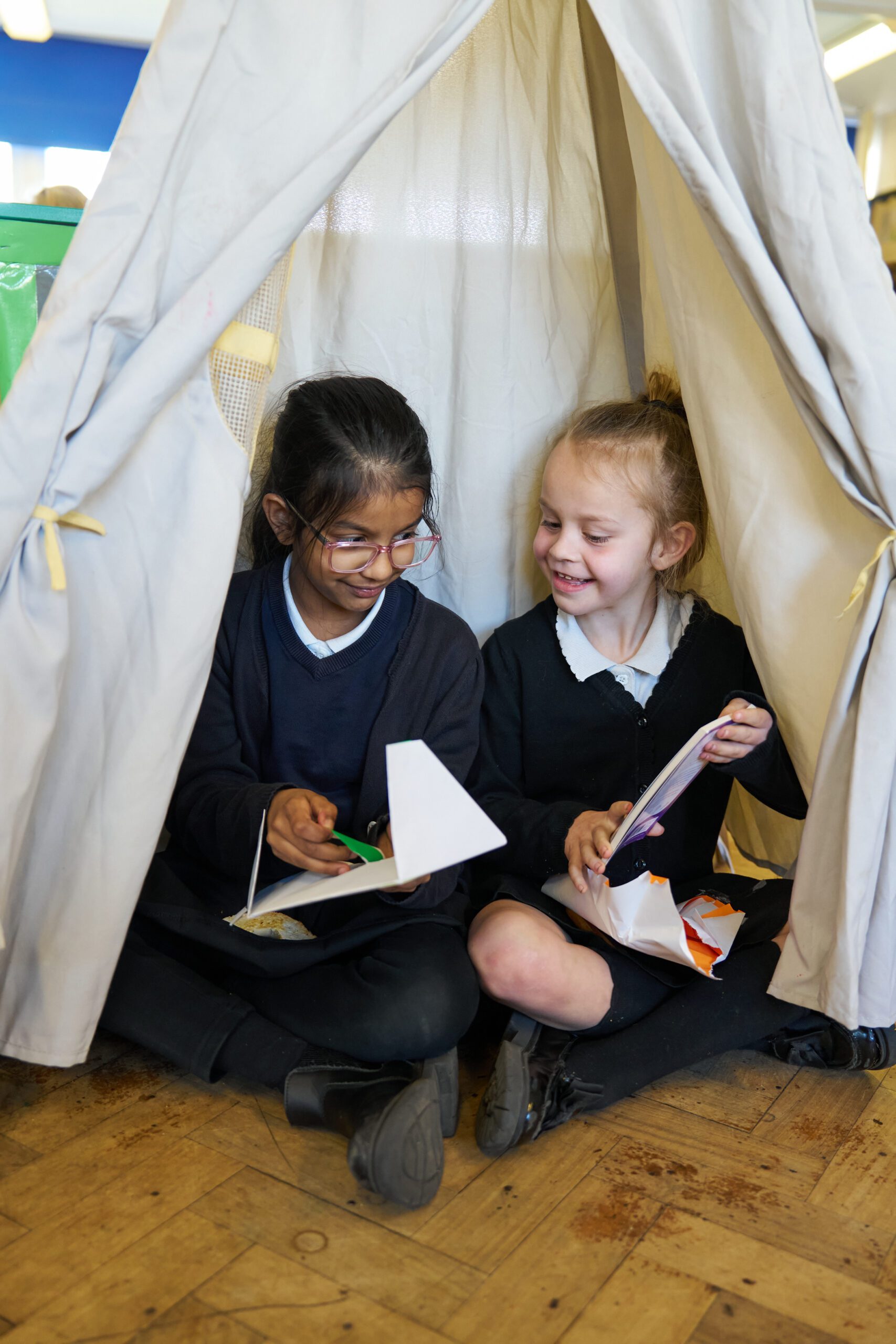
Sabine’s research in collaboration with the National Literacy Trust has shown that multilingual children are more likely to read for pleasure than those who do not speak another language at home, and last year, we shared her work on creating Rivers of Multilingual Reading, to help understand children’s reading development across multiple languages, and what reading is important to them. This year, she has worked with teachers Vikki Varley and Daisy Whitehead, and the children at Lydgate Infant School Sheffield, to show what embedding multilingualism in shared reading and storytelling might look like.
The first film shares hints and tips for shared reading using World Book Day Video Stories, although the tips are transferable to all shared reading:

The second film shows Sabine telling a custom-designed story of “Mara, the Dreammaker”, where multilingualism becomes “mission critical”:

Below, Sabine shares her top tips for embedding multilingualism in shared reading and storytelling:
Getting ready
- First of all, you do not need to be multilingual yourself in order to create a multilingual and linguistically inclusive environment. Position yourself as a willing learner, share any knowledge from school language learning, praise children’s multilingual knowledge – all of these will be met with appreciation.
- Children (and parents!) will typically associate the school environment with English, and may need a bit of coaxing to bring their languages to the table. Setting the scene can help, at least for the first time. Explain that you are interested in children’s languages, and that you think it’s important every child feels all their languages are welcome in the classroom.
- Not all children speak, read, and write equally well across their multiple languages, in fact, many of them do not. Your classroom may include new arrivals, who may still struggle with English, children born in England who have only a rudimentary understanding of their heritage language, and anything in-between. You can level the playing field by sending vocabulary lists home, asking parents to help prepare for a session, or encourage children to look up words they don’t know. Make it clear that any knowledge in different languages is amazing, and encourage children to continue learning across all their languages.
During shared reading/storytelling
- You can either *plan* for multilingual elements, or just let them happen. For example, in Little Red Ridinghood, where she says “Oh my, grandmother, what big eyes/ears/teeth you have”, you could ask children just before the story to share the key words in their home and heritage language, and explain that you would like them to shout these words when it comes to that part of the story. Any story that embeds any sort of choral response or repetitive text lends itself to this. Alternatively, you can stop in the middle of the story, at any point, and check for words. Some words are easier than others: in Little Red Ridinghood, for example, “grandmother” would be easy, “wolf” would be a medium difficulty word, and “woodcutter” would be hard, due to the frequency with which these words might pop up in home conversation.
- Think creatively about what words could be used – key words from the story are an obvious choice, but you could also look at describing a scene, point out colours, count items, explore characters’ moods – depending on age and the story, there will be many ways to meaningfully integrate children’s knowledge.
- Approach children’s languages as an interested listener – if you notice a word sounding similar in different languages, point that out, and encourage children to notice. Try to repeat words in a variety of languages, and encourage others to do so.
- Be mindful of children who don’t speak any language beyond English at home – they may suddenly feel a little left out. Encourage them to learn from a neighbour, or even to pick a language and look up words.
After the story
If a story is embedded in the wider teaching context (rather than a one-off event), there are plenty of ways to support children’s multilingual development:
- If anything gets drawn and labelled as part of the story, encourage children to do that in all their languages. For example, in the story of Mara, the Dreammaker, children could create a drawing of their own dream bag, with items they consider important, and provide names for the items – and the relevant numbers – across all their languages.
- A character description is another great opportunity to embed multilingualism – whether it is via some keywords that describe physical and emotional characteristics (“tall, old, kind”), or a full paragraph, encouraging children to develop their writing across all their languages breaks down language barriers between home and school, and, crucially, gives you as a teacher an idea of whether any difficulties are cognitive (i.e. in understanding) or purely linguistic.
- Create a display board that features children’s multilingualism – whether it is simply key words from the story in the various languages spoken in the classroom, or children’s drawings and stories featuring multilingual elements, making multilingualism visible is a powerful reminder to children that all aspects of their identity are welcome at school.
- Encourage re-telling of the story in children’s home and heritage languages – they could video themselves to tell it orally, or write it, depending on age and language ability.
This may seem like a daunting list, but you don’t have to do all of these ideas every time – instead, treat it like a pick and mix, and dip in little and often to encourage a classroom where linguistic diversity is welcome and supported.
For further ideas and information, please see:
For more classroom activities
www.multilingualism-in-schools.net – a wide variety of classroom activities aimed at supporting multilingualism, including further stories, such as “The Bird of What Who Wouldn’t Sleep” (featuring multilingual/international lullabies), and “The Town Musicians of Bremen”. There is also further information about Rivers of Multilingual Reading, including a film for children and information sheets.
For research
Little, S. (2024) Rivers of multilingual reading: exploring biliteracy experiences among 8-13-year old heritage language readers, Journal of Multilingual and Multicultural Development, 45(2), 323-336. Accessible here.
Teravainen-Goff, A., Clark, C. and Little, S. (2021) Multilingual Young People’s Reading in 2021. National Literacy Trust Research Report. Accessible here
Related resource
Use of World Book Day resources
These resources are free to use for schools, early years settings, libraries, charities, and community groups celebrating World Book Day. Commercial organisations must have a partnership or licence agreement in place before using World Book Day assets. If you are interested in working with us, please contact [email protected].
About the author
Sabine Little
Sabine Little is Professor of Literacy and Multilingualism at the University of Sheffield and Vice President of the UK Literacy Association. A trained teacher, she has been working with and researching multilingual children’s lives for over two decades, often from the perspective of literacy development. Her work on creating Sheffield’s multilingual children’s library has been awarded the international Brenda Eastwood Award for Diversity and Inclusion, and she regularly works with a wide variety of organisations, governments, and charities to create linguistically inclusive environments. With a background in both art and performance, she also regularly works as a storyteller, drawing on children’s languages to create new and exciting multilingual stories in a wide variety of settings.